

GEO: How to Get ChatGPT, Gemini and Perplexity to Recommend You
GEO in practice: how to get ChatGPT, Gemini and Perplexity to cite your business. AI crawlers, quotable content, brand mentions and a 90-day plan.
ReadSEO & GEO
We grow rankings in Google and optimise for AI search engines. No “#1 in a week” promises — just Search Console data you can verify.
In short
SEO (search engine optimisation) is the work of getting your site to rank high in Google. GEO (generative engine optimisation) is its newer sibling: making sure AI assistants — ChatGPT, Gemini, Perplexity or Google AI Overviews — know your brand and cite your site in their answers. We combine both: technical foundations, expert content with data and sources, structured data and building your brand’s footprint across the web.
Results, not promises
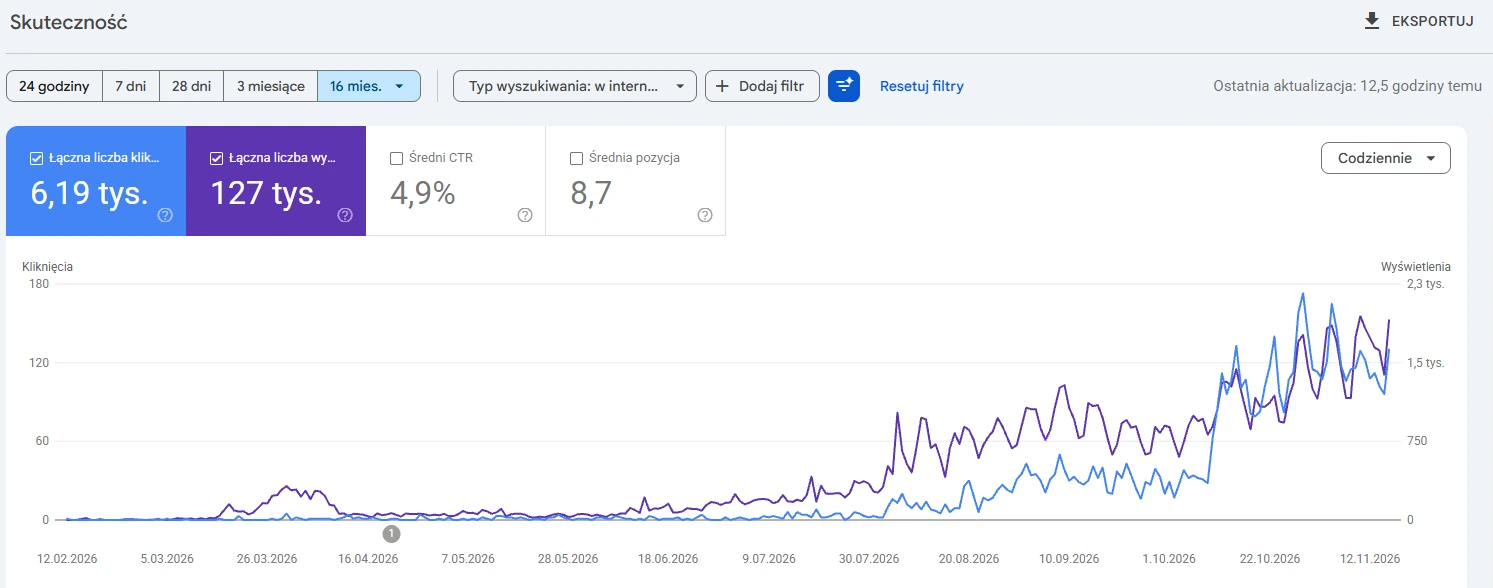
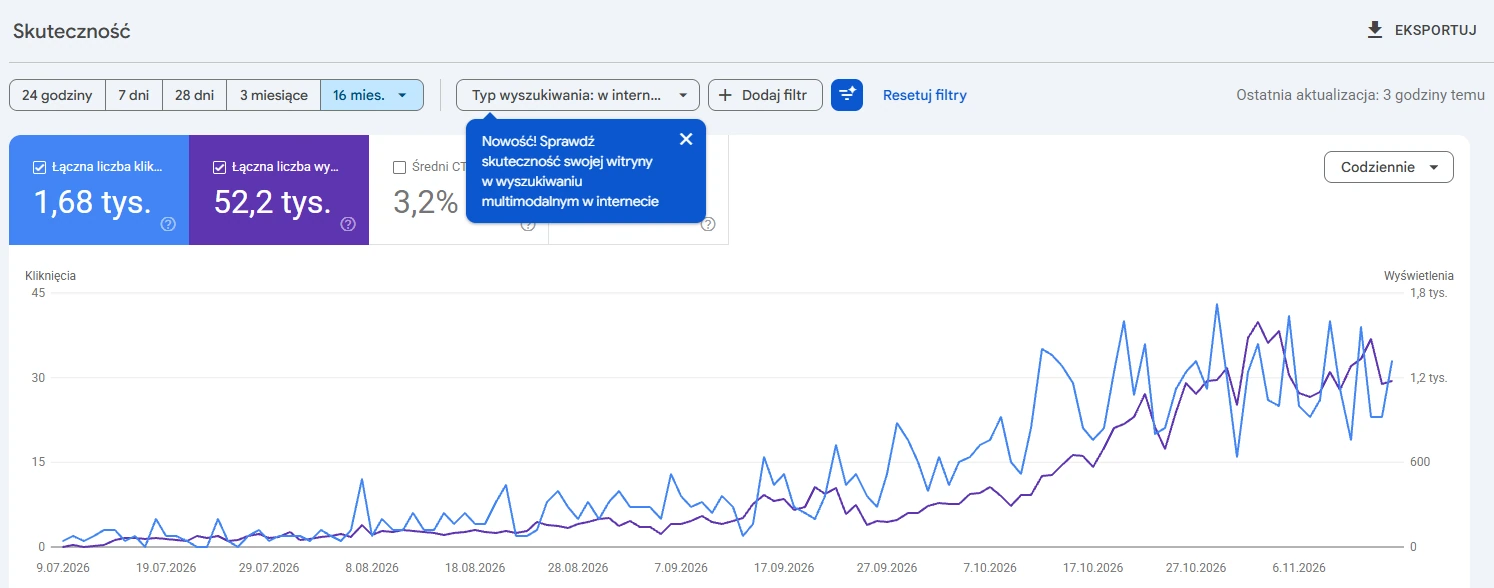
Source: Google Search Console (owner’s dashboard screenshots, November 2026), search type: web.
Who it’s for
Clinics, workshops, offices, renovation firms — in Kraków and beyond. We tidy up your Google Business Profile, reviews and local pages so nearby customers find you, not the competitor down the road.
Category and product pages that pull in traffic from Google, filters that don’t create duplicate pages, and product structured data. Most often on WooCommerce.
Manufacturers, software houses, consultancies. When a buyer asks ChatGPT or Perplexity for a supplier in your field, you want to be in that answer — we work on the expert content and brand recognition that make it possible.
A new domain starts from zero, and a redesign without a redirect plan can wipe out traffic you worked hard for. We lay the foundations from day one — that’s how we started with shadowbrand.pl in July 2026.
Sound familiar?
You pay for SEO but can’t tell what has actually been done.
Every month you get a report built on Search Console and GA4: clicks, impressions, the queries that grew, a list of changes we shipped and the plan for next month. You see the data in your own account.
Customers ask ChatGPT about businesses like yours, and you’re not in the answers.
We rework your most important pages to answer customers’ questions up front, tidy up your business data (schema.org, Google Business Profile, directories) and build mentions of your brand beyond your own site.
You get impressions in Google, but few clicks and even fewer enquiries.
We rewrite titles and descriptions to match search intent, separate sales pages from guides so they don’t compete for the same keywords, and route traffic from articles to your service pages.
What you get
Indexing, speed, Core Web Vitals, canonicals, hreflang, sitemaps, redirects and duplicate clean-up.
Answer-first articles with tables, data and sources — easy for language models to use.
Schema.org for your business, services, articles, FAQs and products — a clear definition of who you are and what you offer.
Google Business Profile, consistent NAP data, reviews and local landing pages — for businesses serving their city.
For us, SEO is a repeatable cycle, not a one-off “optimisation”. Each month follows the same pattern:
The cycle works because SEO and development sit in one team. Bartłomiej Chwajoł, who leads SEO and GEO at OrbitBuilder, is also a back-end developer, so a fix to redirects or structured data doesn’t wait weeks in someone else’s queue. For the full list of what we check at the start, see our step-by-step SEO audit checklist.
No made-up charts here. These are Google Search Console figures for two sites we’ve worked on.
olafmotion.com is the motion design studio of Olaf Klimasz, OrbitBuilder’s co-founder, combining an After Effects template library with custom animation work. We focused on content that answers specific search queries: free tools (After Effects Downgrader, Premiere Pro Downgrader) and guides on After Effects, licensing and compatibility. Over 16 months the site earned 6.19k clicks and 127k impressions, with a 4.9% average CTR and an average position of 8.7. Growth picked up clearly in August 2026, and by October and November daily clicks had reached 100–170.
shadowbrand.pl is a Kraków merch studio for creators. Here we started from almost zero visibility in July 2026. We built dedicated production pages (tees, hoodies, embroidered caps, company apparel, event merch), an FAQ and guides answering the questions creators search for. The result: 1.68k clicks and 52.2k impressions at a 3.2% CTR, with daily impressions climbing to 1.2–1.6k in November 2026.
In both cases growth came after several months of steady work, not from a single change. You’ll find more on both projects in our portfolio.
In SEO it’s easy to promise a lot and show very little. So we stick to a few simple rules.
We cover the technical side of AI visibility in our article on structured data, llms.txt and AI crawlers, and content strategy for AI assistants in our guide to GEO and getting ChatGPT to recommend you. If you serve customers in your own city, start with our piece on local SEO in Kraków.
Process
We review indexing, speed, site structure, content and competitors, plus what AI assistants currently say about your business. We record a baseline so there’s something to compare results against a few months on.
We choose keywords and customer questions, group them into topics and assign each to a specific page. We decide what to fix, what to write from scratch and in what order.
We remove indexing blocks and duplicates, fix redirects, speed and structured data, and tidy up internal linking. It’s the foundation your content needs in order to work.
We expand service pages and publish articles that answer customers’ questions. Every piece targets a clearly assigned keyword and leads to your offer.
We compare Search Console and GA4 data against the baseline and repeat the AI assistant question test. That sets the plan for the following month.
Engagement options
For businesses that want to know what’s holding their visibility back and have someone to implement the fixes.
For businesses that want steady growth in Google and AI answers without building an in-house SEO team.
For businesses that want one team running their visibility and developing the website at the same time.
Scope of work
Tools & technology
Comparison
| One-off audit | Ongoing work | |
|---|---|---|
| What you get | A report with a prioritised task list | Implementation, content and a monthly report |
| Who implements changes | Your team, or us as a separate job | We do — in the code, in WordPress and in the content |
| Content | Topic and page structure recommendations | Articles and page expansion every month |
| AI visibility | A one-off test of customer questions | The same test every month, with results compared |
| Timeline | Usually 1–2 weeks | Results usually after 3–6 months |
| Best for | You have a developer and a copywriter and need a diagnosis and a plan | You want growth without building an in-house SEO team |
FAQ
SEO competes for a position in Google’s results list. GEO makes sure your brand and site get cited in AI-generated answers. The foundations are shared (a fast, well-described site, expert content), but GEO leans harder on clear definitions, data, sources and brand recognition.
First changes in Search Console usually appear within weeks, with steady traffic growth after 3–6 months. olafmotion.com, for example, took off a few months after the work started — today it gets 100–170 clicks a day.
No — and don’t trust anyone who does. Google itself says nobody can guarantee rankings. We guarantee solid work, transparent reports and data-driven decisions.
Yes — we regularly ask AI assistants the questions your customers ask and track whether and how your brand appears and which sources get cited. Content planning follows from that.
It’s a proposed standard: a plain-text Markdown file at your site root that lists your key pages for language models. It doesn’t replace SEO, but it’s a cheap addition — this site has one too.
On how competitive your industry and target keywords are, the technical state of your site, the number of pages or products and how much content needs writing. Reach matters too: local, national, or international with several language versions. We quote individually, after a call and an initial look at your site.
An SEO and GEO audit usually takes 1–2 weeks. The most urgent fixes, such as indexing blocks or broken redirects, go live straight after the audit, and the remaining technical work usually takes 2–4 weeks. After that, content is published on a steady monthly schedule.
Access to Google Search Console, GA4 and your site’s admin panel (e.g. WordPress) or hosting. A list of the services or products that matter most to you, your customers’ most common questions and the names of your main competitors also help. If you don’t have Search Console or GA4 yet, we’ll set them up under your account.
Everything we created: the content, changes to the code and site structure, structured data, and the Search Console and GA4 accounts, which are yours from the start. Rankings don’t vanish overnight, although without ongoing work competitors may overtake you in time. We can also hand over documentation and a forward plan to your team.
Insights

GEO in practice: how to get ChatGPT, Gemini and Perplexity to cite your business. AI crawlers, quotable content, brand mentions and a 90-day plan.
Read
A step-by-step SEO audit checklist: indexing, redirects, content, Core Web Vitals, structured data and AI search visibility, with tools and priorities.
Read
How to get cited in Google AI Overviews and AI Mode: technical requirements, query fan-out, llms.txt myths and the new Search Console AI report, sourced.
ReadQuote
Quotes are free. Tell us what you want to achieve — we’ll come back with questions, first ideas and a plan.
Services
We use essential cookies and, with your consent, analytics (Google Analytics, Hotjar) and marketing cookies to understand how you use the site and improve it. Details in our privacy policy.
